This egg types comparison covers the four types of eggs most people come across: pasture raised, organic, soy & corn-free, and duck eggs. We’ll cover what changes between them, how they taste, and how to choose the right one for your kitchen.
Eggs look the same from the outside. Same carton, same shape, and same aisle in the grocery store.
But spend any time in Lancaster County, or really anywhere people are paying attention to how food gets made, and you start to realize: not all eggs are the same.
They taste different, they cook differently, and the way they’re raised matters more than the label usually lets on.
Here’s what actually changes between them, and why people end up choosing differently.
Why Egg Types Matter More Than Most People Think
Most people don’t set out to compare eggs; they just grab a carton.
But egg labels only tell part of the story. What actually shapes the egg, the yolk color, the flavor, the texture, the nutrition, comes down to three things:
What the hen eats. How she lives. How much variety she has in her day.

The differences between pasture raised, organic, soy & corn-free, and duck eggs start with farming and feed, but they don’t end there. They carry all the way through to your kitchen: how the egg fries, how a cake rises, or how rich a custard sets, for example. Understanding what shapes each type of egg makes it a lot easier to choose the right one for how you actually cook and what priorities you have for your nutrition.
Types of Eggs Explained
Pasture Raised Eggs
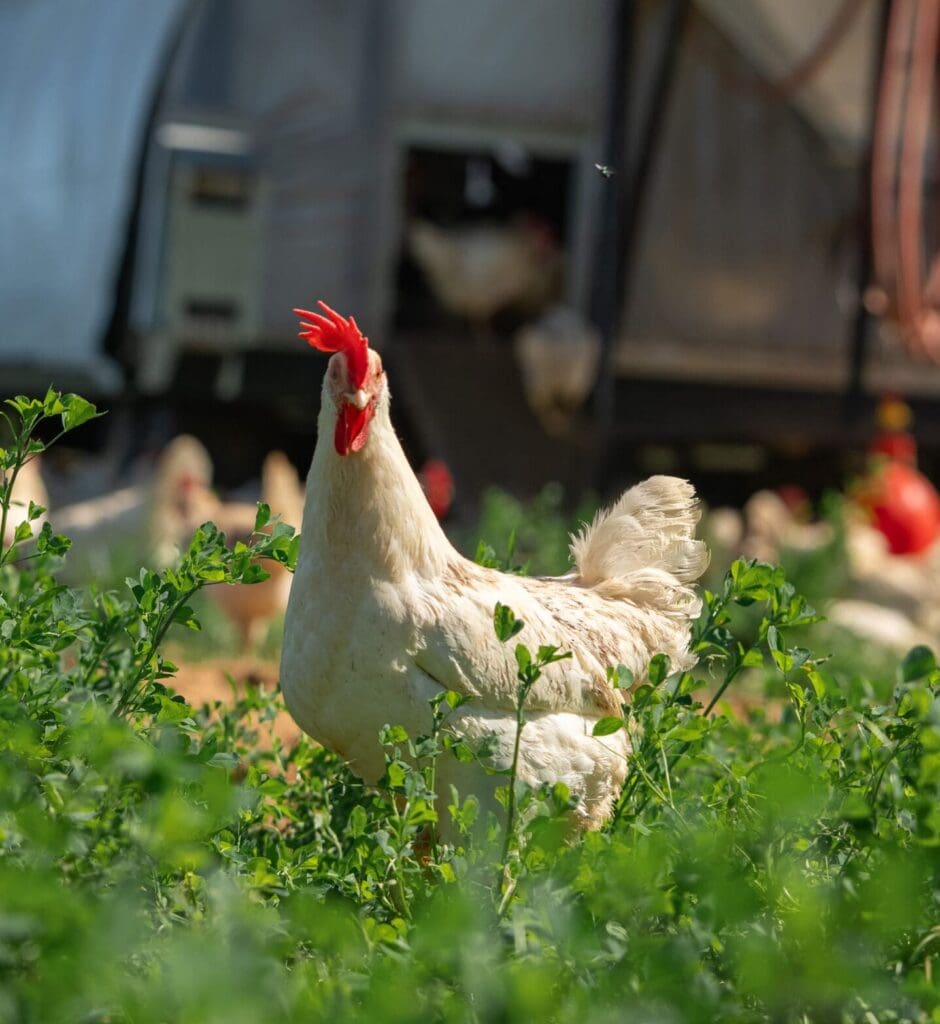
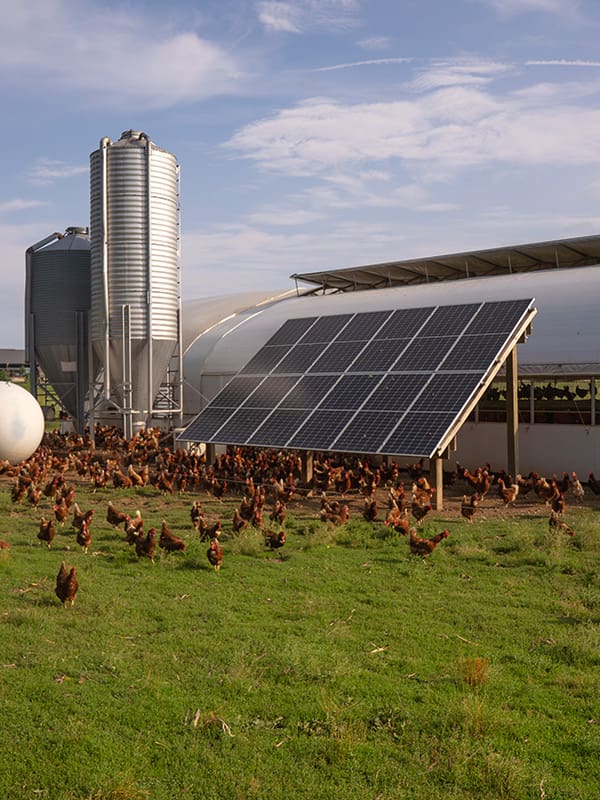
Pasture raised eggs come from hens that spend real time outdoors on grass and open land, with regular access to forage including insects, seeds, and plants. That outdoor life, and the variety it provides, is what sets pasture raised eggs apart from conventional and cage-free eggs.
You’ll usually notice a deeper, more golden yolk. A richer, fuller flavor. A little more presence in the taste overall. Nutritionally, pasture raised hens tend to produce eggs with higher omega-3 fatty acids and more fat-soluble vitamins like A, D, and E than hens raised in conventional systems, because those nutrients come largely from the varied outdoor diet.
But honestly, that’s not what most people notice first. They usually just notice: this tastes like more egg.
Pasture raised eggs are the most versatile type on this list. They work well for everyday cooking, hold up beautifully in baking, and perform reliably across whatever you’re making. If there’s one type that works as a daily staple and still delivers noticeably better quality than conventional eggs, this is it.
At Utopihen, our hens are raised on farms in the Lancaster County area with real room to roam and forage. Not just a small door that technically qualifies as outdoor access. The hen’s life matters to us. Certified humane requires 108 sq. ft. per bird, but we give our hens 110 sq. ft. of grassy pasture per hen.
Organic Eggs
Organic eggs come from hens fed certified organic feed, meaning no GMOs, no synthetic pesticides in feed ingredients, and more tightly controlled sourcing overall. The USDA organic certification governs what goes into the feed, not how the hens are housed or how much outdoor time they get.

Organic is a feed standard. It ensures cleaner inputs into the system and gives buyers more confidence about what the hens are eating. What it does not guarantee is a more varied outdoor environment or the lifestyle conditions that produce the richer flavor and nutrition people associate with pasture raised eggs.
So what you get with organic eggs is a cleaner, more controlled feed system with a familiar, reliable flavor profile. If ingredient transparency and feed sourcing are your primary concerns, organic eggs deliver on that. If you want both the feed standards and the outdoor life, you need pasture raised organic eggs.
At Utopihen, we offer pasture raised organic eggs because we don’t think you should have to choose between the two. Clean feed and real outdoor access are both achievable, and we wanted to build them into the same egg.
Soy & Corn-Free Pasture Raised Eggs
Soy and corn are the backbone of most commercial poultry feed. They’re efficient, they’re widely available, and they’ve been the default in the industry for a long time. Removing them is a deliberate choice, not a standard one.
Soy & corn-free pasture raised eggs come from hens on pasture, raised with a more intentional feed approach that excludes these common ingredients. People choose them for different reasons: some have ingredient sensitivities, some just want more transparency around feed sourcing, and some want tighter control over what they’re putting into their bodies. It’s usually a personal decision more than a cooking one.
It’s worth being clear about what changes and what doesn’t. The pasture access is the same. The outdoor life, the foraging, the varied diet from real land: all of that still drives the quality of the egg.
The feed refinement matters, but it matters most when it’s built on that foundation. A soy & corn-free egg from a hen that never sees the outside of a barn is a very different thing from a soy & corn-free egg from a hen on open pasture in and around Lancaster County.
For most people, this is a preference-driven choice rather than a functional one. The egg doesn’t behave differently in the pan, but it’s about what you want to put in your body and how you want your food to be produced.
Pasture Raised Duck Eggs
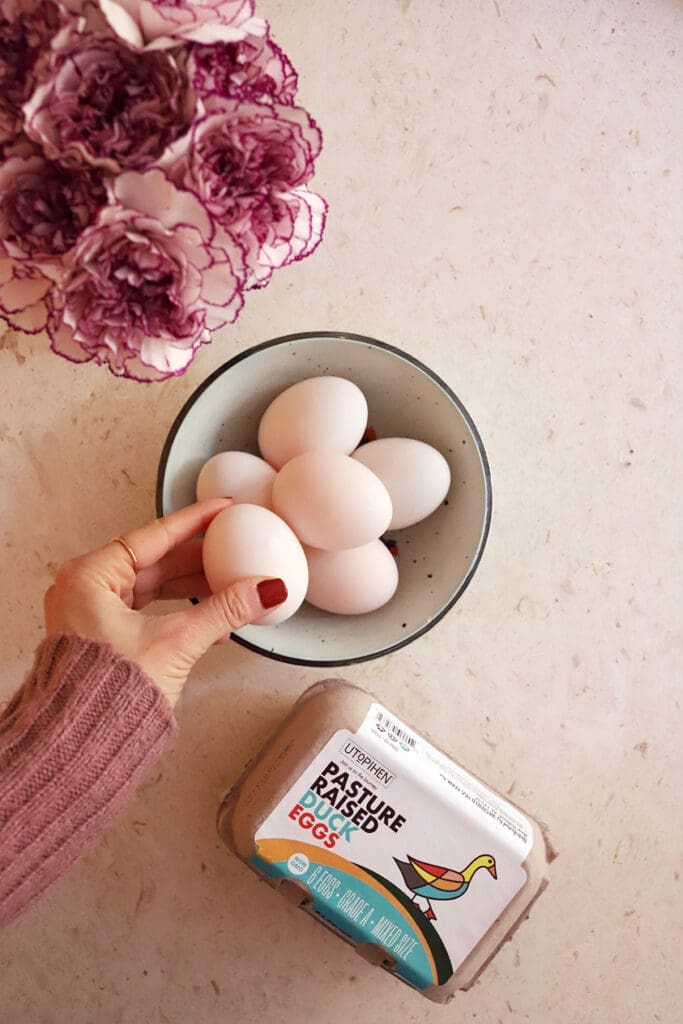
Pasture raised duck eggs are eggs laid by ducks raised with real outdoor access on grass and open land. Like pasture raised chicken eggs, the farming system shapes the quality, but the species difference is what really sets duck eggs apart.
Duck eggs have a larger yolk-to-white ratio than chicken eggs. That changes almost everything about how they taste, how they cook, and what they bring to a recipe.

You’ll notice more richness, a creamier texture, and a deeper, more concentrated flavor. The yolks are bigger and a noticeably deeper color, which means your scrambled eggs, your hollandaise, and your lemon curd will all look better too.
In baking especially, the difference is hard to miss. Cakes made with duck eggs rise higher and stay softer longer, and custards and quiches set with a creamier texture. The higher fat content in duck egg yolks is what makes baked goods tender, moist, and rich in a way that’s difficult to replicate with chicken eggs.
Duck eggs work 1:1 in place of chicken eggs in almost any recipe. You don’t need to adjust quantities or rethink your technique. The one exception is recipes that depend on whipped egg whites, like meringues or angel food cake. Duck egg whites have more protein, which sounds like a good thing until you’re trying to whip them into stiff, stable peaks. For those recipes, stick with chicken eggs.
Nutritionally, duck eggs bring more protein (7 to 9 grams per egg versus roughly 6 in a chicken egg), nearly three times the omega-3 fatty acids, a bigger yolk loaded with fat-soluble vitamins A, D, and E, and more choline. Calorie-wise, duck eggs run about 100 calories each compared to 70 to 90 for a chicken egg. You’re getting more of everything, including the calories, but the nutrition scales up with them.
Duck eggs also stay fresh longer than chicken eggs. Their shells are significantly thicker and harder, which keeps them fresh for up to six weeks refrigerated. That longer shelf life means less waste at home and less lost in shipping, which matters to us as much as it probably matters to you. Fewer eggs end up being thrown out before they’re used.
Egg Types Comparison
Sometimes it helps to see everything side by side.
| Egg Type | What Shapes It | What You Notice First | Shelf Life | Best Use |
| Pasture Raised Chicken | Outdoor access and forage-based diet | Richer flavor, deeper yolk | 3 to 5 weeks refrigerated | Everyday cooking |
| Organic | Feed standards and sourcing rules | Clean, familiar taste | 3 to 5 weeks refrigerated | Ingredient-focused buying |
| Soy & Corn-Free Pasture Raised | Feed refinement plus pasture system | Subtle but intentional difference | 3 to 5 weeks refrigerated | Preference-based eating |
| Pasture Raised Duck | Species difference plus pasture system | Rich, creamy, dense texture | Up to 6 weeks refrigerated | Baking and richer cooking |
What Each Egg Tastes Like
Taste is usually where people start when they’re comparing egg types.
Conventional and standard organic eggs tend to taste mild and familiar. There’s nothing wrong with that. It’s just a neutral, reliable flavor that most people grew up with.
Pasture raised chicken eggs taste a little deeper and more full, with a yolk that stands out more in both color and flavor. The difference is noticeable but not dramatic, and most people describe it as a better version of what they already know.
Duck eggs are usually the most noticeable shift. They taste richer and creamier, more intense, but in a way that still feels like an egg. The whites firm up a little more when cooked, and the yolks are bigger and more flavorful. If you want to really taste the difference, scramble them simply with a little butter and salt. That’s where egg quality is clear.
Most people who try duck eggs for the first time say something like: “Oh, that’s just a really good egg.”
Pasture Raised vs. Organic Eggs: The Key Difference
This comparison comes up often, and the short answer is: they measure different things.
Pasture raised is about how the hen lives. It describes outdoor access, space to move, and a varied diet from real land. It’s a farming and welfare standard.
Organic is about what the hen eats. It describes feed quality, sourcing, and the absence of synthetic inputs. It’s a feed and certification standard.

Neither one automatically includes the other. An organic egg can come from a hen that rarely goes outside. A pasture raised egg can come from hens fed non-organic feed. The two standards address different parts of the equation.
If you want both, look for eggs that carry both certifications, like ours. That’s when you get clean feed and a genuinely better life for the hen. Both matter. Both show up in the egg.
How to Choose the Right Egg
Most people stop asking which egg is “best” and start asking something simpler: what actually works for how I cook?
Reach for pasture raised chicken eggs when you want a reliable, flavorful everyday egg. They’re the most flexible option on this list and the easiest to cook with across the board.
Reach for organic eggs when feed sourcing and ingredient transparency matter to you. The egg won’t behave differently in a recipe, but you’ll have more confidence in what went into producing it.
Reach for soy & corn-free pasture raised eggs when you want more control over inputs. This is usually a personal preference or sensitivity-driven choice, not a cooking decision.
Reach for duck eggs when you’re making something that benefits from richness. Baking especially. Most people don’t fully switch to duck eggs for everything. They keep them on hand for the recipes where they know the extra yolk is going to matter, and those recipes get noticeably better.

A lot of kitchens end up with both chicken eggs and duck eggs in the fridge. Different eggs for different days. Different eggs for different recipes.
At Utopihen, we raise all four because different kitchens use eggs differently. There isn’t one right answer. There are just different needs, and we’d rather help you match the egg to the job than tell you one type is the only one worth buying.
What they all share is the same foundation: hens raised with care on pasture in and around Lancaster, Pennsylvania, where how food gets produced still matters to the people doing it. That part we won’t compromise on.
Egg Types FAQ
What are the main types of eggs?
The most common egg types are pasture raised eggs, organic eggs, soy & corn-free pasture raised eggs, and duck eggs. They differ mainly in farming systems, feed standards, and species. Within each category, the quality of outdoor access and the hen’s actual living conditions matter as much as the label.
Are pasture raised eggs better than organic eggs?
Pasture raised eggs and organic eggs are not better or worse than each other; they measure different things. Organic focuses on feed quality and sourcing standards. Pasture raised focuses on the hens’ living conditions and outdoor access. The best option is an egg that’s both pasture raised and certified organic, which is what we offer at Utopihen.
What makes duck eggs different from chicken eggs?
Duck eggs have a higher yolk-to-white ratio than chicken eggs. That means more richness, more fat-soluble vitamins, more omega-3 fatty acids, and a creamier flavor. It also means they perform differently in cooking, especially baking, where the extra yolk fat produces softer, richer results.
Can you substitute duck eggs for chicken eggs in recipes?
Yes. Duck eggs work as a direct 1:1 substitute for chicken eggs in almost any recipe. The exception is recipes that depend on stiffly whipped egg whites, like meringues or angel food cake. For those, chicken eggs are more reliable.
Why do pasture raised eggs taste different from conventional eggs?
Our pasture raised hens have access to 110 sq feet per bird which provides them with a more varied outdoor diet, including grass, insects, and seeds. That variety changes what goes into the egg. The yolk ends up deeper in color and richer in flavor, and the overall taste is fuller and more present. The hen’s life shows up in the egg.
Are all organic eggs pasture raised?
No. Organic certification refers to feed standards, specifically the absence of GMOs and synthetic pesticides in feed ingredients. It says nothing about outdoor access or how much space the hen has. An organic egg can come from a hen with very limited outdoor time.
Which eggs are the healthiest?
Pasture raised duck eggs are the most nutrient-dense option, with more protein, more omega-3 fatty acids, more choline, and higher levels of fat-soluble vitamins than conventional eggs. Pasture raised chicken eggs are also significantly more nutritious than conventional eggs. The healthiest egg is generally one from a hen that had real outdoor access and a varied diet, regardless of species.
How long do duck eggs last compared to chicken eggs?
Duck eggs last longer than chicken eggs because their shells are significantly thicker and harder. Refrigerated duck eggs stay fresh for up to six weeks. Chicken eggs are generally best within three to five weeks of the pack date. That longer shelf life means fewer duck eggs get wasted at home, and fewer are lost in shipping before they reach you.
What are the best eggs for baking?
Duck eggs are widely considered the best eggs for baking because of their higher yolk fat content. Cakes made with duck eggs tend to rise higher, stay moist longer, and have a richer flavor. Pasture raised chicken eggs are also excellent for baking and more accessible for everyday use. The one baking application where chicken eggs outperform duck eggs is anything that relies on stiffly whipped egg whites.