Key Takeaways:
-
- Duck eggs contain many nutritional benefits such as more protein, omega-3 fatty acids, choline, and fat-soluble vitamins than chicken eggs, making them a nutrient-dense option for health-conscious eaters.
-
- Duck eggs have a richer flavor and larger yolks, which helps cakes, pastries, pasta, custards, and other baked goods achieve better texture, moisture, and color.
-
- Neither egg is universally better. Duck eggs excel for nutrition and baking, while chicken eggs remain the more affordable, widely available choice and perform better in recipes that rely on whipped egg whites.
So, Which One Is Actually Better?
People ask us that all the time, which is better, duck eggs or chicken eggs? And honestly, it depends.
Once you understand the real differences between duck eggs and chicken eggs (the nutrition, the taste, the benefits, the trade-offs), you’ll probably stop thinking of it as an either/or. A lot of people we talk to end up keeping both in their fridge. Different eggs for different days. And if you’re a cook or a baker, eggs for different recipes.
At Utopihen, we raise both pasture raised chicken eggs and pasture raised duck eggs on farms rooted in Lancaster County, Pennsylvania, one of the most storied farming regions in the country. Let’s lay it all out so you can decide for yourself.
Chicken Eggs: Let’s Give Credit Where It’s Due
Before we get into what makes duck eggs special, we have to acknowledge that chicken eggs are one of the most remarkable foods that exist.
A pasture raised chicken egg packs:
-
- 6 grams of protein
-
- ~37 mg of omega-3 fatty acids (meaningfully higher than conventional eggs)
-
- All nine essential amino acids, which make them a complete protein
-
- Vitamins A, D, E, B2, B12, and folate
-
- Choline: most people are chronically short on this nutrient, and it plays a big role in brain health, liver function, and fetal development
-
- Selenium, phosphorus, and iodine
-
- Lutein and zeaxanthin: these antioxidants, found mostly in the yolk, are genuinely good for your eyes
All of that in roughly 70-90 calories, depending on the size of the egg. That’s a remarkable amount of nutrition for the calorie cost. Chicken eggs have been a dietary staple across virtually every culture on earth forever, and it’s not hard to see why.

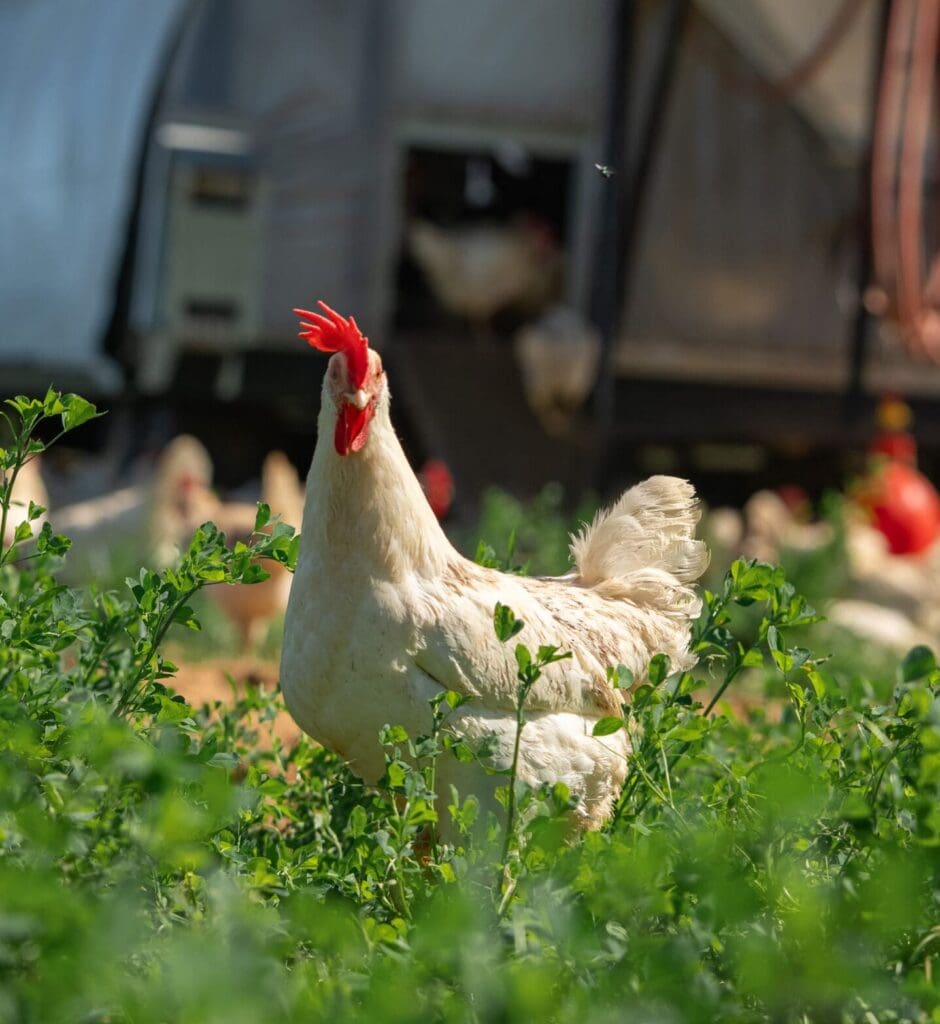
Pasture raised eggs, like ours, go further than what you’ll find in the standard grocery aisle. When hens actually spend time outside on real grass, the eggs show it: deeper yolks, better flavor, better nutrition. The hen’s life matters. It shows up in the egg.
Duck Egg Nutrition and Benefits
Duck eggs have been in kitchens and cultures around the world for a long time. In the US, they’re still a bit of a discovery for most people. Chefs have known about them for years. Bakers swear by them. And people who are focused on nutrition tend to become pretty devoted once they try them.
The nutritional benefits of duck eggs over chicken eggs are real and measurable. Here’s what’s inside a pasture raised duck egg:
-
- 7-9 grams of protein per egg
-
- ~100mg of omega-3 fatty acids (compared to ~37mg in a chicken egg)
-
- All eight essential amino acids: isoleucine, leucine, lysine, methionine, phenylalanine, threonine, tryptophan, and valine
-
- Vitamins and minerals across the board, and in most cases at higher levels per gram than you’d get from a chicken egg
-
- A bigger yolk, which is where the fat-soluble vitamins live (A, D, E, and K)
-
- More choline than chicken eggs
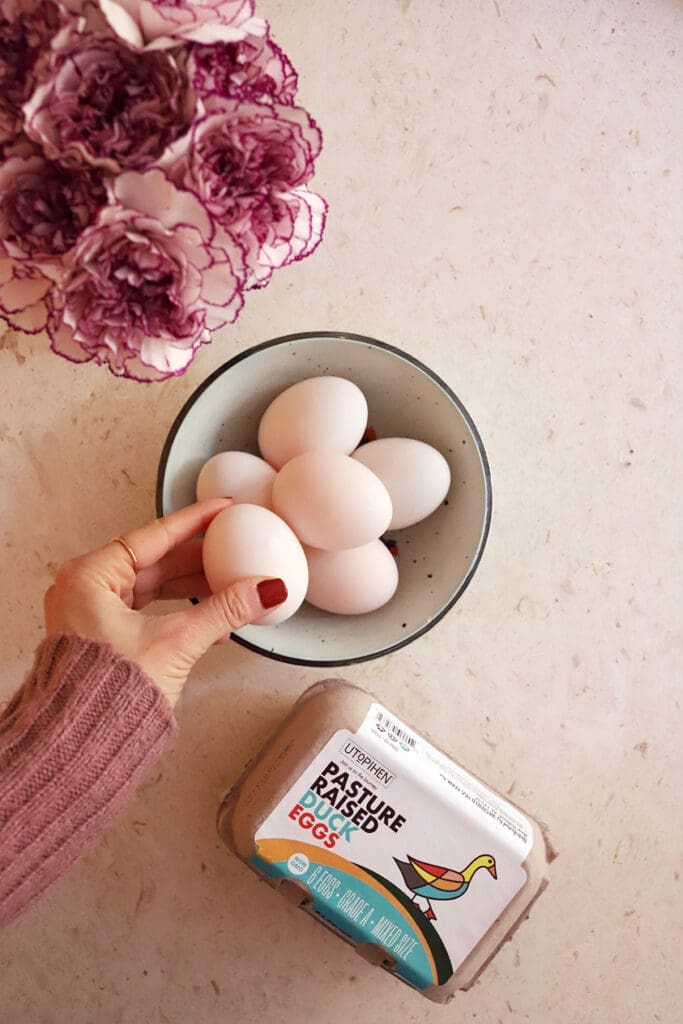
Our duck eggs come in a mixed-size six-pack, mostly large, extra-large, and jumbo. They’re bigger eggs in general. But the size isn’t the point. It’s what’s in them.

The extra protein comes from the larger whites. The extra omega-3s come from that bigger yolk-to-white ratio. Neither of these things happened by accident. It’s just how ducks are built.
Duck Eggs vs. Chicken Eggs: The Numbers
| Pasture Raised Duck Eggs | Pasture Raised Chicken Eggs | |
| Protein | 7-9g | ~6g |
| Omega-3 | ~100mg | ~37mg |
| Calories | ~100 | ~70-90 |
| Yolk size | Larger | Smaller |
| Shell thickness | Thicker | Thinner |
| Shelf life | Longer | Standard |
| Choline | Higher | Good source |
| Vitamins A, D, E | Higher (larger yolk) | Good source |
| Availability | Specialty / growing | Widely available |
| Best for baking | Richer rise, deeper flavor | Reliable, consistent |
| Best for meringues / angel food | Trickier (richer whites) | Ideal |
| Flavor | Richer, creamier | Classic, familiar |
| Price | Higher | More accessible |
Duck Eggs and Omega-3: Why the Difference Matters
Nearly three times the omega-3s of a chicken egg is not a small difference. And omega-3s are one of those nutrients most of us are genuinely not getting enough of through diet alone.
The reason duck eggs have so much more comes down to that larger yolk. Omega-3 fatty acids are fat-soluble, so they concentrate in the fat-rich yolk. Bigger yolk, more omega-3s. Simple as that.
Omega-3s show up in research related to:
-
- Heart health
-
- Brain function and clarity
-
- Eye health
-
- Joint and bone health
-
- Inflammation
-
- Mood, including depression and anxiety
-
- Sleep
-
- Skin health
-
- Focus in kids with ADHD
If you’re trying to get more omega-3s through real food rather than supplements, duck eggs are a genuinely good way to do it.

Duck Egg Calories vs. Chicken Egg Calories
A duck egg has roughly 100 calories. Chicken eggs come in at closer to 70-90 calories, depending on size. So yes, duck eggs have more, but you’re also getting more protein, more fat, and more nutrients in that egg. For most people, that’s a trade-off that makes sense.
Using Duck Eggs for Baking: Why So Many Bakers Never Go Back
This is probably the most practical reason people make the switch, or at least start keeping pasture raised duck eggs on hand alongside their chicken eggs.
The fat content in a duck egg yolk is higher. That fat is what makes baked goods tender, moist, and rich. Cakes made with duck eggs rise higher and stay softer longer. Pastries get a more complex flavor. Pasta comes out silkier. Custards and quiches set with a creamier texture.
The yolks are also a noticeably deeper color, which means your scrambled eggs, your hollandaise, your lemon curd, everything just looks better.
And here’s the practical part: duck eggs swap 1:1 for chicken eggs in any recipe. You don’t need to adjust quantities or change your technique. You just crack a duck egg where you’d normally crack a chicken egg.
When Chicken Eggs Are Actually the Better Choice
There are times when chicken eggs are the right call.
For meringues, angel food cake, and anything that relies on whipped whites. Duck egg whites have more protein, which sounds good until you’re trying to whip them into stiff, stable peaks. They behave differently. Chicken egg whites are more cooperative for these kinds of recipes, and the lighter texture they produce is part of the point.
For everyday cooking on a budget. Duck eggs cost more. If your household goes through two or three dozen eggs a week, the price difference adds up fast. Pasture raised chicken eggs give you excellent nutrition at a more accessible price point.
For feeding kids or picky eaters. Chicken eggs are familiar. There’s real value in that. If you’re not sure how someone will respond to a slightly richer egg, starting with a great pasture raised chicken egg is a perfectly good move.
When you just need eggs, and the store has what it has. Duck eggs are getting easier to find, but they’re still not everywhere. Chicken eggs are. Sometimes that’s what matters most.

What Do Duck Eggs Taste Like Compared to Chicken Eggs?
Richer. Creamier. A little more intense, but in a way that feels like more of what an egg already is, not like something foreign.
Most people who try them for the first time say something like “oh, that’s just a really good egg.” Which is kind of the best possible review.
The whites firm up a little more when cooked. The yolks are bigger and more flavorful. If you want to really taste the difference, scramble them simply with a little butter and salt. That’s where the quality of an egg shows up most clearly.
The Shell (This Is the Environmental Part)
Duck eggs have significantly thicker, harder shells than chicken eggs. We think about this a lot because food waste is something that keeps us up at night, not as a talking point, but as a real problem we want to be part of solving. That ethos runs deep in Lancaster County farming, and it runs deep at Utopihen too.
A thicker shell means:
-
- Duck eggs stay fresh longer, so fewer end up thrown out at home or pulled from shelves
-
- They break less during shipping and handling, which means less waste before they even reach you
-
- The whole supply chain benefits, from the farm packing table all the way to your refrigerator
It might sound like a small thing. But when you think about how many eggs get wasted every year globally, small things start to add up. Choosing duck eggs is one concrete, low-effort way to generate a little less waste. We appreciate that about them.
So, Which Egg Should You Buy?
Here’s how we think about it:
Duck eggs make a lot of sense if you bake regularly, you’re focused on protein or omega-3 intake, you follow keto or paleo, you love trying great ingredients, or you just want to know what the fuss is about.

Chicken eggs make a lot of sense if you need a reliable everyday egg at a better price, you’re making something that depends on whipped whites, you’re feeding people who aren’t adventurous eaters, or duck eggs just aren’t available near you yet.
Both make a lot of sense if you like matching the ingredient to the job. A lot of home cooks and bakers end up here. Duck eggs for weekend baking and special cooking. Chicken eggs for the weekday scramble. It’s not complicated.
Duck Eggs vs. Chicken Eggs FAQs
1. Are duck eggs better for you than chicken eggs?
Duck eggs have more protein, more omega-3 fatty acids, and higher levels of most vitamins and minerals than chicken eggs. So nutritionally, yes, duck eggs edge ahead. That said, a pasture raised chicken egg is also a really nutritious food. It’s not like you’re choosing between good and bad. You’re choosing between good and slightly more of the good stuff.
2. Can you substitute duck eggs for chicken eggs in recipes?
Yes. Duck eggs are a direct 1:1 substitute for chicken eggs in almost any recipe. The main exception is recipes that depend on stiffly whipped egg whites, like meringues or angel food cake, where chicken eggs are more reliable. For everything else, especially baking, duck eggs usually make the result better.
3. What do duck eggs taste like?
Duck eggs taste richer and creamier than chicken eggs, like a more intense version of a chicken egg, not something foreign. Most people like them immediately. A few can’t tell the difference. We’ve never had anyone say they tasted bad.
4. Are duck eggs good for people with chicken egg allergies?
Some people with chicken egg sensitivities find they tolerate duck eggs fine. But egg allergies are complicated and personal, so please talk to your doctor before experimenting.
5. How long do duck eggs last compared to chicken eggs?
Duck eggs last longer than chicken eggs, thanks to their thicker shells, up to six weeks refrigerated. Chicken eggs are generally best within three to five weeks of the pack date.
6. What is the nutritional difference between duck eggs and chicken eggs?
Duck eggs have more protein (7-9g vs ~6g), nearly three times the omega-3s (~100mg vs ~37mg), a bigger yolk with more fat-soluble vitamins, and more choline. Chicken eggs are slightly lower in calories and much easier to find. Both are excellent, especially pasture raised.
7. Are Utopihen duck eggs pasture raised?
Yes. Our pasture raised duck eggs come from ducks raised on farms in and around Lancaster County, PA with regular access to pasture and a non-GMO diet. If you want to know more about how they live, head over to our farms page. We like showing people around.
Why We Love Duck Eggs
We didn’t start Utopihen because we thought the egg market needed another brand. We started it because we genuinely think the way most eggs are produced could be better: better for the animals, better for the land, and better for the people eating them.
We farm in the Lancaster County area, a region with a long, deep tradition of doing things right. That environment shapes how we think. It means giving hens and ducks real space. It means feed we believe in. It means farming practices we’d be comfortable explaining to anyone. We hold our chickens and our ducks to the same standard because both deserve it.
You can reach for our pasture raised duck eggs or our chicken eggs. Either way, you’re getting something raised with actual care on Pennsylvania pasture. That’s the part we won’t compromise on.