
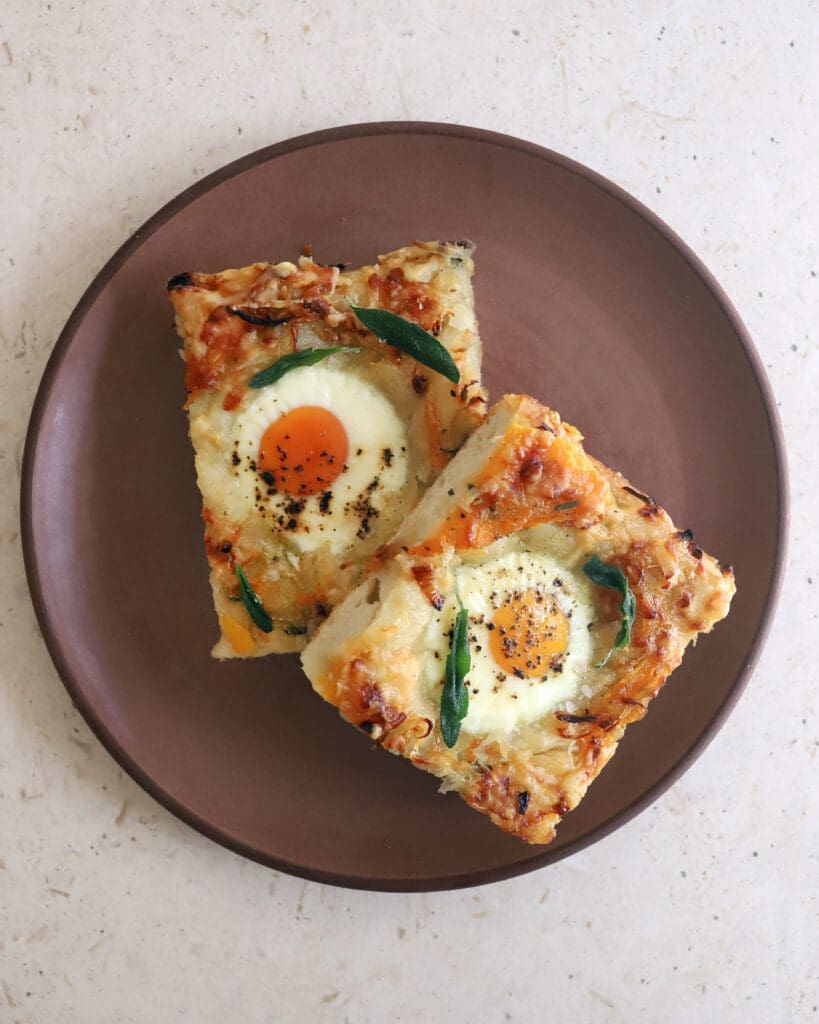
Fall Breakfast Focaccia with Butternut Squash, Caramelized Shallots, Gruyère & Baked Eggs
This Fall Breakfast Focaccia layers roasted butternut squash, caramelized shallots, nutty Gruyère, fresh sage, and softly baked eggs over an airy, golden focaccia. It is savory and rich without feeling overly heavy, with the sweetness of the squash and shallots balancing the salty cheese and herbaceous sage.
Prep Time
15-75 hours
Cook Time
35 Min
Serves
6
Ingredients
For the Focaccia Dough:
- 4 1/4 cup All-Purpose Flour (or 510 grams if you’re working off a scale)
- 2 teaspoons Kosher Salt (11 grams)
- 2 teaspoons Instant Yeast (7 grams)
- 2 Cups Lukewarm Water (455 grams)
- 6ish tablespoons Extra Virgin Olive Oil, divided
- Baking Spray
For the Toppings:
- 1 cup Butternut Squash (peeled and sliced into 1/4-inch pieces or half-circles)
- 3 Shallots (medium, thinly sliced lengthwise)
- 1 cup Gruyère Cheese (freshly grated)
- 5 large Fresh Sage Leaves (roughly chopped + 10 whole small leaves for topping)
- 4 Large Pasture Raised Eggs
- 1 tablespoon Unsalted Butter
- 1 tablespoon Extra-Virgin Olive Oil (plus additional for roasting, greasing, and finishing)
- Kosher Salt as needed
- Flaky Sea Salt as needed
Preparation
To Mix Your Dough
- In your mixing bowl, whisk together flour, salt, and instant yeast.
- Add water. Use your rubber spatula to mix it into a sticky blob-like ball.
- Rub olive oil all over the top of your dough. This is to keep it from forming a crust on its surface while it’s cold-proofing.
- Cover the top of your bowl with cling wrap. Do NOT press it down to touch your dough. Your dough will need lots of space to rise.
- Refrigerate for a minimum of 12 hours and up to 72. I let this batch sit in the fridge for 20 hours.
To Second Proof Your Focaccia
- Spray your baking pan with baking spray.
- Pour 1 tablespoon of olive oil in the middle of your 9×13-inch pan.
- Use your two forks to dislodge the dough from the sides and base of your bowl. Scrape and pull toward the center of your mixing bowl. Lift and transfer your dough into your greased baking pan and roll it around to coat it fully in the olive oil.
- Let it sit uncovered on your counter for 3 hours for its second proof.
To Roast the Butternut Squash
- Preheat the oven to 425°.
- Toss the butternut squash with a drizzle of olive oil, salt and freshly ground black pepper. 3. Arrange the squash in a single layer on a baking sheet. Roast for 12–15 minutes, turning once, until just tender and beginning to caramelize around the edges. Avoid roasting until completely soft, as the squash will continue cooking on the focaccia.
- Remove from the oven and set aside.
To Caramelize the Shallots
- Melt 1 tablespoon of unsalted butter and 1 tablespoon of olive oil in a skillet over medium-low heat.
- Add the shallots and a generous pinch of kosher salt. Cook for 10–15 minutes, stirring occasionally (rarely), until soft, golden, and jammy. If the skillet becomes dry before the shallots are ready, add another teaspoon of olive oil. Keep the shallots lightly golden rather than deeply browned, as they will continue cooking in the oven.
- Remove from the heat and set aside.
To Prepare the Egg Wells
- Drizzle the surface of the focaccia with olive oil. Using oiled fingertips, gently dimple the exposed dough without completely deflating the bubbles.
- Generously coat the outsides of your 4 small ramekins with olive oil.
- Gently but firmly press each ramekin into the dough to create a substantial indentation. Do not press the ramekins completely through the dough to the bottom of the pan.
To Top + First Bake
- Scatter half of the Gruyère, half of the caramelized shallots, approximately two-thirds of the roasted butternut squash, and the torn sage leaves around the ramekins. Keep the area immediately surrounding each ramekin relatively clear so the egg wells remain defined.
- Bake at 425° for 15 minutes with the ramekins in place. The focaccia should rise substantially, develop enough structure to hold the wells, and begin to turn pale golden, but it should not be completely baked.
To Add the Eggs
- Carefully lift the hot ramekins straight out of the focaccia.
- Arrange the remaining butternut squash, caramelized shallots, and Gruyère around the egg wells. 3. Crack each egg individually into a small bowl, then gently slide one egg into each well. 4. Lightly season each egg with kosher salt and freshly ground black pepper.
The Final Bake
- Return the focaccia to the 425° oven and bake for 7–9 minutes, beginning to check the eggs after 6 minutes.
- Remove the focaccia when the egg whites are opaque and set, the yolks remain soft and glossy, and the focaccia is deeply golden. The Gruyère should be melted and the squash and shallots lightly caramelized.
To Crisp the Sage
- Heat 1–2 tablespoons of olive oil in a small skillet over medium heat.
- Add the reserved whole sage leaves in a single layer and fry for 15–30 seconds, just until they stop bubbling vigorously and become crisp. Do not allow the leaves to brown.
- Immediately transfer the sage leaves to a paper towel and season with a very small pinch of flaky sea salt. Side note / Bonus: Reserve the sage-infused olive oil.
To Finish + Serve
- As soon as the focaccia comes out of the oven, arrange the crispy sage leaves over the surface. 2. Allow the focaccia to rest for approximately 5 minutes before cutting into squares. 3. Eat & enjoy!
NOTES
- Do not overload the focaccia with toppings. The airy, bubbly bread should remain a prominent part of the finished dish, with the squash, shallots, Gruyère, sage, and eggs integrated into the focaccia rather than covering it like a pizza.
- Keep the butternut squash approximately 1/4 inch thick so it retains its shape while becoming tender enough to bite through easily.
- Generously oil the ramekins, particularly around the lower outside edges, to help them release cleanly from the highly hydrated dough after the par-bake.
- Adding the toppings in two stages allows the first layer to bake into the focaccia while keeping the final layer distinct and visible on the finished surface.
- Crisp the whole sage leaves just before serving. The fried leaves provide concentrated sage flavor and delicate texture, while the reserved sage-infused olive oil adds a subtle aromatic finish.
Recipe creation: Coffee and Champagne